Stripe Review 2026: Pricing, Features, and Hidden Costs
If you’ve built a business online, you’ve probably heard of Stripe. It’s the payment processor that developers love, startups swear by, and enterprise brands quietly depend on. But as we move through 2026, the landscape has shifted. New competitors have emerged. Fee structures have grown more complex. And businesses of every size are asking the same question: Is Stripe still worth it?
This Stripe review 2026 breaks down everything — from pricing and hidden costs to standout features and real-world limitations — so you can make an informed decision before committing your revenue stack to any platform.
What Is Stripe?
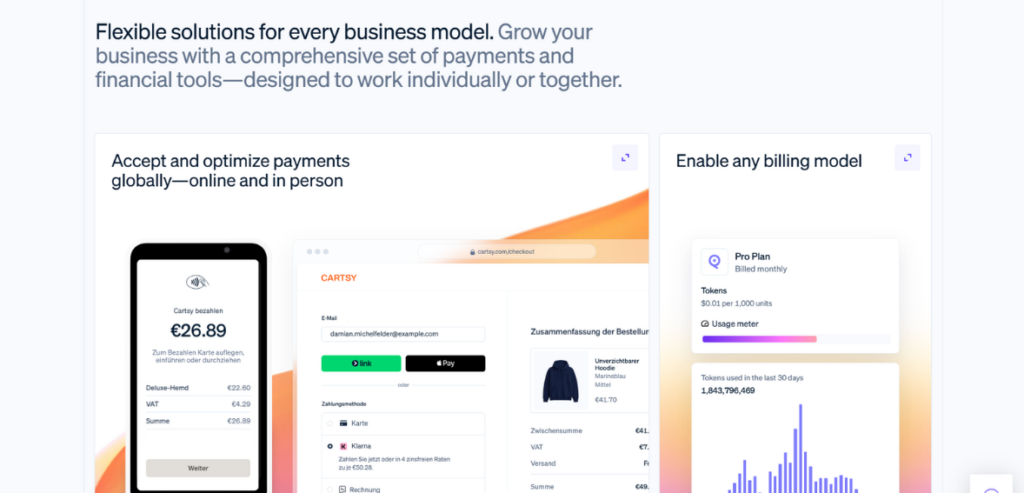
Image source
Stripe, founded by two Irish brothers, Patrick and John Collison, is an advanced payment processing platform designed for the Internet age, rather than legacy systems built for an earlier time. By 2026, Stripe is much more than an account that processes payments and provides a suite of financial services. These services include billing, business finance management, fraud prevention, banking, and compliance support.
Stripe’s ability to provide this suite of services demonstrates its many capabilities. For many of the services Stripe offers, especially this approach to breadth, there is an inherent cost.
Stripe Pricing 2026: What Does It Actually Cost?
The most often cited payment processing fee is 2.9% plus $0.30 for standard online payment processing in the US. This fee applies to nearly all credit/debit cards, including Visa, Mastercard, and American Express. The pricing system seems straightforward until you start adding up all the exceptions.
International cards incur a 1.5% fee. Conversion adds 1% to that. If there’s a payment failure in your subscription-based service, you incur the costs of additional retry logic. For large B2B deals, ACH direct debit is cheaper at 0.8% with a maximum of $5. For retail-based scenarios, Stripe’s in-person card reader rates become more competitive at 2.7% + $0.05.
With a $1 million annual revenue, a business can negotiate a lower rate through enterprise sales. A custom contract can be purchased, but there is no public rate card. This can be a budgeting disadvantage.
Stripe’s Core Features: What You’re Actually Getting
Stripe Payments
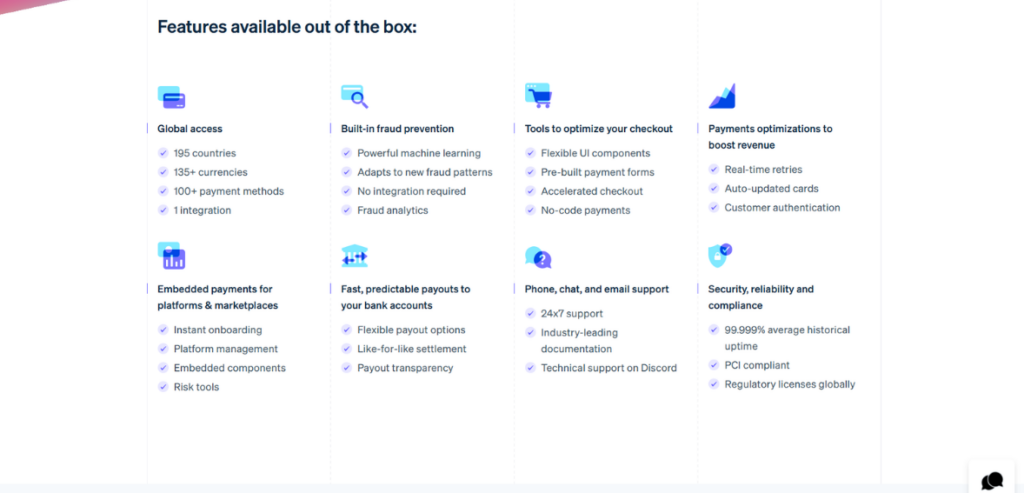
The core payment experience remains industry-leading. Stripe Checkout provides a pre-built, conversion-optimized payment page that handles everything from card input to 3D Secure authentication. For developers who want more control, the Stripe Elements library lets you embed fully customizable payment forms directly into your own UI. The checkout flow supports over 100 payment methods globally, including Apple Pay, Google Pay, Link, Klarna, and regional methods such as iDEAL and Alipay.
Stripe Billing
For businesses that have a subscription model, Stripe Billing is almost certainly a fully developed option. It covers features such as metered billing, tiered pricing, free trials, proration, and automated dunning (the recovery of failed payments). The retry logic is smart and can reduce involuntary churn, which is one of the product’s lesser-known features. Most SaaS companies that use Stripe billing have listed it as the main reason they continue to use the platform.
Stripe Radar
Every platform has an in-built machine learning fraud-detection engine that serves as an additional security layer. These platforms usually analyze data at the global level and process payments for millions of businesses. Stripe operates such a platform and flags suspicious payments in real time. Such a service is free for the average user and is included in standard Stripe pricing. The premium version, Radar for Fraud Teams, offers more detailed controls and charges an additional $0.02 per screened transaction. That premium is usually worth it, especially for businesses in a high-risk sector.
Stripe Connect
Stripe Connect is made for marketplace and platform businesses. For any product that involves a two-sided marketplace or a gig-economy app where money is exchanged between users, Connect is likely the infrastructure you need for your business, as it handles onboarding, payouts, compliance, and split payments. Here, the more complex pricing model depends heavily on the use case. Standard Connect is free; Custom and Express accounts have different per-transaction charges.
Stripe Atlas
Stripe Atlas is useful for international entrepreneurs who want to start a business in the United States. Stripe Atlas will establish your company as either a Delaware LLC or a Delaware C-Corp, obtain your free EIN, and perform basic legal requirements, starting at $500 plus an annual fee. Though Stripe Atlas is not the least expensive option, it is the most compelling for non-US customers because it sets up a Stripe account, allowing them to sell to US customers in the fastest possible timeframe.
Stripe vs. Competitors in 2026
Stripe vs. PayPal
PayPal is almost certainly Stripe’s biggest competitor for merchants that service customers who prefer the PayPal wallet experience. PayPal’s average rates are 3.49% + $0.49 for regular transactions, making it more expensive than Stripe for the vast majority of transactions. PayPal still has the most brand recognition, which translates to conversions for certain audiences. Rather than choosing one, many companies use both methods simultaneously.
Stripe vs. Square
Among the current offerings in the brick-and-mortar space, Square is a more natural competitor. In-person processing rates roughly match Stripe’s, but Square’s ecosystem is more attuned to brick-and-mortar businesses, with storefronts, POS, and employee management tools. Stripe suits software-based and API-centric businesses. Given this, Square is better in simplicity and in-person solutions, and Stripe is better in flexibility and developer experience.
Stripe vs. Braintree
Braintree, a subsidiary of PayPal, provides similar developer-friendly payment products and, in the past, was more open to negotiating custom rates with lower-volume minimums. For companies that process payments of $80,000 or more each month, it may be that Braintree offers better pricing than Stripe advertises. The trade-off would be a simpler developer experience and fewer available features.
The Hidden Costs of Using Stripe
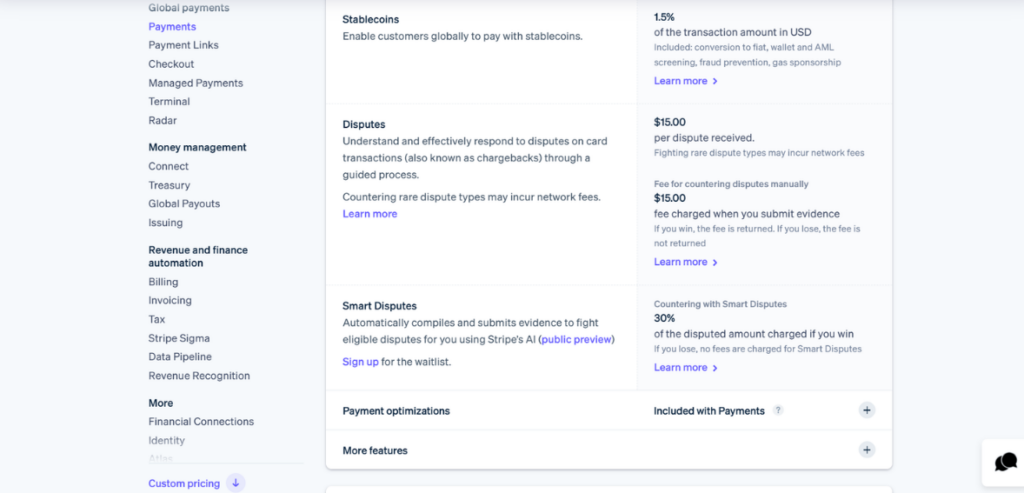
This is where many businesses get surprised. The 2.9% + $0.30 baseline is just the starting point. Disputed charges — also known as chargebacks — cost $15 per dispute, regardless of outcome. If you win the dispute, the fee is not refunded unless you’re enrolled in Stripe’s chargeback protection product, which costs an extra 0.4% per eligible transaction. Instant payouts, which let you access your funds in minutes rather than waiting 2 business days, carry a 1.5% fee with a minimum of $0.50.
The extra cost of premium support is a nasty surprise for many customers. With standard support, Stripe handles cases through chat, email, and phone. For time-sensitive issues, support plan holders receive priority. But that comes with a quote-based cost. This is a huge cost for many small businesses that assumed paid services come with support.
Stripe Tax is the built-in automated tax calculation and tax filing service offered by Stripe. When tax is calculated, Stripe charges an additional 0.5% fee for that transaction. For companies located in multiple states or international companies, this fee is significant over a 12-month period.
Stripe Review: Who Should Use Stripe in 2026?
Stripe is not the right fit for every business. It shines brightest for technology-forward companies — SaaS platforms, e-commerce brands with engineering resources, marketplaces, and B2B software businesses. Its API depth, documentation quality, and feature breadth are unmatched in the industry. For a developer-led company, Stripe’s ecosystem is genuinely hard to beat.
Businesses that provide support over the phone, work mainly offline, or are just starting and don’t have as many technical resources may view the platform as complicated and expensive. High-risk merchants in industries like supplements, adult content, and firearms will often find that Stripe does not support their category.
For freelancers and very early-stage businesses, the per-transaction fees can feel steep compared to alternatives like Wave or Payments by HoneyBook. Volume is the key variable. The more you process, the better your unit economics become on Stripe’s standard pricing model.
Is Stripe Reliable? Uptime and Support in 2026
For years, Stripe has dominated the payments processing field and offered its customers technology on the cutting edge of what is available. Stripe’s client uptime is above 99.99%. Also, Stripe is one of the most reliable and honest tech operations on the market. Pricing for services is clear, service outages are listed in full transparency, and there are constant updates on what the service is doing to advance tech for business. When outages occur, they are resolved quickly.
The weaker side of the reliability story is human support. The platform’s asynchronous support model works well for minor issues but creates real friction when an account is flagged, funds are held, or a dispute needs immediate escalation. Account holds — where Stripe pauses your payouts pending a review — are not uncommon for businesses experiencing sudden volume spikes. That experience can be stressful, especially for businesses with tight cash flow.
Conclusion
Stripe remains one of the most powerful and well-designed payment platforms available in 2026. Its feature depth, developer experience, and global reach make it the benchmark against which every competitor is measured. For the right kind of business, it’s not just good — it’s the obvious choice.
That said, it isn’t cheap or simple. The full cost of using Stripe — once you factor in chargebacks, dispute fees, premium support, currency conversion, and add-on products — is meaningfully higher than the headline rate suggests. Understanding those costs upfront is the difference between a payment stack that serves your business and one that quietly erodes your margins.
If you’re a developer-led company with growing transaction volume, Stripe in 2026 is still worth it. If you’re a small business prioritizing cost simplicity and human support, it’s worth exploring your alternatives before committing.
Frequently Asked Questions
Is Stripe free to use in 2026?
Stripe has no monthly fee or setup cost on its standard plan. You only pay when you process a transaction. However, optional features such as Radar for Fraud Teams, Stripe Tax, and priority support each carry additional costs that can add up quickly as your business scales.
What are Stripe’s biggest hidden fees?
The most commonly overlooked costs are the $15 chargeback dispute fee, the 1.5% instant payout fee, the 1.5% international card surcharge, and the additional 1% currency conversion fee. Businesses operating internationally or in high-dispute categories feel these most acutely.
Does Stripe offer volume discounts?
Yes — but only through direct negotiation. Stripe’s public pricing is flat-rate, but businesses processing over $1 million annually can contact Stripe’s sales team for custom interchange-plus pricing. There’s no public threshold or automatic discount trigger.
How does Stripe compare to PayPal in 2026?
For most online businesses, Stripe offers lower per-transaction fees and a significantly more flexible developer experience than PayPal. PayPal still holds an edge in consumer recognition and can drive conversion among buyers who prefer wallet-based checkout. The two platforms aren’t mutually exclusive — many businesses offer both at checkout.